
Why Is My BMW Overheating? 9 Causes in UAE Summer (and What to Do)
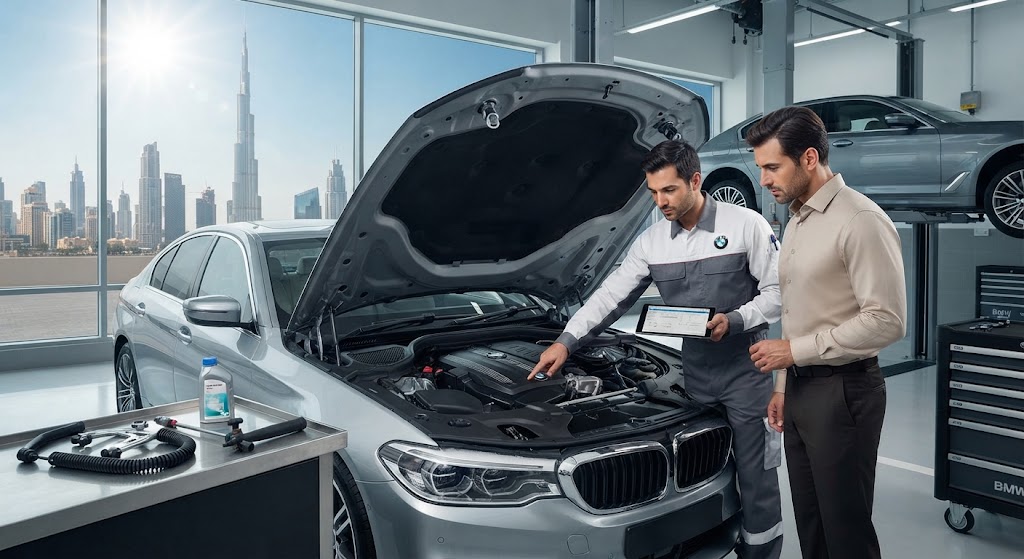
"The temperature warning has just come on and it's 46°C outside, so why is my BMW overheating?" In most cases it's a tired electric water pump, a thermostat stuck shut or a radiator fan that can't keep up, and the first job is stopping safely before the engine suffers lasting damage.
A BMW usually overheats because coolant has stopped circulating or isn't being cooled properly. On modern models the usual culprits are a failed electric water pump, a stuck thermostat, a leak from the expansion tank or hoses, or a dead radiator fan. Stop safely, switch off, let the engine cool and never open a hot coolant cap.
What to do immediately if your BMW overheats
Many calls that begin with "why is my BMW overheating?" come from drivers who are still on the road, so we start here. Knowing what to do when a BMW overheats in the first few minutes is what stops a cooling-system repair from becoming a cylinder head job.
Follow these steps in order, even if the car still feels normal.
- Switch the AC off and the heater to maximum. With the blower on high, the heater matrix works as a small extra radiator, and the condenser stops adding heat in front of the radiator.
- Find a safe place to stop. Pull onto a hard shoulder or into a petrol station, switch on your hazards and stand clear of traffic.
- Turn the engine off. A fan that keeps running afterwards is normal on many BMWs.
- Open the bonnet only when there is no steam. Releasing trapped heat helps, but steam and escaping coolant can scald.
- Wait at least 30 to 45 minutes. An engine sheds heat slowly in summer, so give it time.
- Check the coolant level only once the engine is cold. If it is low, top up with BMW-approved coolant mix, opening the cap slowly under a thick cloth to release any remaining pressure.
- Arrange recovery if the warning comes back. Don't keep driving on a red warning.
Never open the expansion tank cap on a hot engine. The cooling system is pressurised, and coolant above 100°C can burst out and cause severe burns.
Can you drive it to a workshop?
That depends on the message and what happens once the car has cooled. A yellow warning that clears, with coolant at the correct level, usually allows a short, gentle drive with the AC off. A red warning, an empty tank, steam or a sweet coolant smell in the cabin means a recovery truck.
The reason: an aluminium cylinder head distorts quickly once coolant boils away, so a few extra kilometres can separate a pump replacement from a machined head.
Understanding BMW overheating warnings and messages
Many BMWs from the mid-2000s onwards have no traditional temperature needle, so the first sign of trouble is usually a message on the instrument cluster or iDrive screen. The BMW engine overheating warning light is a thermometer symbol, and its colour tells you how urgent the problem is. Wording varies by model.
Yellow: "drive moderately"
A yellow thermometer with a "drive moderately" message means coolant temperature has climbed above its normal range. The engine management may reduce power and switch off the AC compressor to cut heat. Treat it as an instruction: drop your speed, avoid hard acceleration and get the car inspected the same day.
Red: "engine overheated"
The red version means the engine has reached a temperature where damage is likely if it keeps running. Stop as soon as it is safe and switch off. Restarting repeatedly to see whether the warning has cleared only adds heat to a stressed engine.
Coolant level low
This comes from a level sensor in the expansion tank and often appears days before any temperature message, making it your most useful early clue. Coolant doesn't simply evaporate from a sealed system, so a low level means it is escaping somewhere.
A healthy BMW can run its coolant above 100°C at light load, because the electronically controlled thermostat allows it for efficiency and the pressurised system raises the boiling point. Trust the warning messages over any reading in an app.
Why is my BMW overheating? 9 common causes
Ask a BMW technician "why is my BMW overheating?" and the answer almost always falls into one of three groups: coolant not circulating, coolant escaping, or heat not leaving the radiator. The BMW overheating causes below are listed roughly in the order our technicians find them on modern petrol and diesel models.
1. A failed electric water pump
Many BMW petrol engines from the mid-2000s onwards, including the N52, N54, N55 and N20, use an electric coolant pump. It controls cooling precisely, but its motor and electronics wear out, and constant heat speeds that up.
Failure is often sudden, with no leak to warn you: typically a "drive moderately" message, the fan roaring at full speed and pump fault codes. In our workshop we confirm it by commanding the pump through diagnostic software. Some newer petrol engines and most diesels use a belt-driven main pump instead, which usually weeps from its seal before failing.
2. A thermostat stuck closed
The thermostat decides when coolant flows to the radiator. BMW's map-controlled thermostats combine a wax element with a small electric heater, and either part can fail. Stuck closed, it traps hot coolant in the engine while the top radiator hose stays noticeably cooler than it should.
3. A cracked expansion tank or weak pressure cap
Thousands of heat cycles eventually crack the plastic expansion tank's seams and bleed screw. The cap matters just as much: it holds the system under pressure, which raises the boiling point, so a worn seal lets coolant boil sooner and escape as steam. Look for dried coolant crust around the tank and a level that creeps down week by week.
4. A blocked or leaking radiator
Radiators fail from both sides. Outside, sand, dust and insects pack into the fins of the radiator and the AC condenser in front of it. Inside, scale from tap water or mixed coolants narrows the tubes. BMW radiators also use plastic end tanks crimped to an aluminium core, and those joints start to seep with age.
After a sandstorm, ask for the gap between the AC condenser and radiator to be inspected and cleaned. Dust packed there is invisible through the grille, yet it can cut cooling enough to trigger warnings in slow traffic.
5. Leaking coolant hoses and plastic pipes
BMW uses a mix of rubber hoses and plastic pipes joined by quick-release connectors and clips. Years of engine-bay heat harden the rubber and make the plastic brittle, so an old connector can crack the moment it is disturbed. Small leaks often land on hot metal and evaporate, which is why you may smell coolant long before you see a drip. A cold pressure test reveals leaks that normally only show once the system is hot.
6. A faulty radiator fan
The large electric fan behind the radiator, often called the auxiliary fan, does most of its work at low speed. On many BMWs it is a variable-speed unit with its own control module, so it can fail electrically as well as mechanically. A weak fan causes overheating in queues and car parks that recovers once you pick up speed; we test it by commanding it through diagnostics.
7. Low or incorrect coolant
Coolant also carries corrosion inhibitors matched to the metals, plastics and seals inside a BMW engine. Topping up with tap water or a generic product dilutes that protection and encourages scale, and some incompatible mixes form sludge. BMW specifies its own approved coolant, normally mixed 50/50 with distilled or demineralised water.
8. Air trapped after a repair
If the overheating started soon after cooling-system work, suspect trapped air. Air pockets collect around the pump and cylinder head, where they stop coolant reaching the hottest metal. Symptoms include a temperature that swings up and down, cold air from the heater and gurgling behind the dashboard.
Many BMWs with an electric pump have a built-in venting routine, and a vacuum filler stops air getting in at all. A rushed bleed is a common reason a fresh repair seems not to work.
9. Head gasket failure (rare, but serious)
Head gasket failure is rarer than owners fear and usually follows an earlier severe overheat rather than starting one. Signs include sweet-smelling white exhaust smoke, coolant vanishing with no visible leak, bubbles rising in the expansion tank, hoses that feel hard on a cold engine and a milky deposit under the oil filler cap.
We never condemn one on symptoms alone. A combustion-gas test of the coolant, a leak-down test and a compression test give a definite answer before anything is dismantled.
BMW overheating when the AC is on
If your BMW overheats when AC is on but stays steady with it off, the cooling system is working close to its limit and the AC is the extra load that tips it over. The condenser sits directly in front of the radiator, so the air reaching the radiator has already been warmed by the refrigerant. Crawling through 45°C traffic leaves very little margin.
The AC also makes the engine computer demand more fan speed. A fan that has lost performance may cope with the engine alone but not with the condenser too, so fan faults often surface first as an AC complaint.
When a car comes in with this pattern, our technicians check:
- Fan operation at each commanded speed, using diagnostic software
- Dust and debris packed between the condenser and radiator
- Refrigerant pressures, because an overcharged or restricted AC system runs a hotter condenser
One useful clue: warmer vent air just before the temperature warning usually means the engine computer has cut the compressor, pointing to the cooling system rather than the AC.
Temperature warning on your BMW? Get the cooling system checked
Our technicians test the water pump, thermostat, radiator fan and pressure cap to find out why your BMW is running hot, and we explain the findings before any work starts. Call or WhatsApp us to book an overheating diagnosis.
BMW overheating but coolant full: what it means
This is where the answer to "why is my BMW overheating?" is least obvious. A full expansion tank only proves there is coolant in the tank, not that it is reaching the engine or losing heat in the radiator. Cars that reach us overheating with a full tank usually have one of these faults:
- No circulation. A dead electric water pump leaves coolant standing still while the engine heats up.
- Thermostat stuck shut. Coolant cannot reach the radiator, however much of it there is.
- An air lock. Trapped air around the pump or head blocks flow while the tank level looks normal.
- A blocked radiator. Coolant flows, but scale inside or dirt outside stops it shedding heat.
- A failed fan. The coolant is fine; the airflow is not.
- A faulty temperature sensor. Occasionally a sensor or wiring fault sends a false reading and the engine isn't overheating at all.
- A head gasket leak. Combustion gas forced into the coolant can make the tank look overfull or bubbly.
To tell them apart, our technicians read live coolant temperatures from the engine and radiator sensors, command the pump, compare radiator inlet and outlet temperatures and pressure-test the system.
If the tank level rises sharply as the engine warms, or a steady stream of bubbles appears, stop driving. Combustion gas may be entering the coolant, and every extra journey makes the repair bigger.
BMW overheating repair cost in Dubai
Cost depends on which part failed, your engine, how much has to come off to reach the part, and the parts option you choose. These approximate ranges include typical labour at an independent BMW specialist.
| Cause | Typical symptom | Approx. repair cost (AED) |
|---|---|---|
| Electric water pump (often with thermostat) | "Drive moderately" message, fan at full speed, no visible leak | 1,800 – 4,500 |
| Thermostat only | Rapid temperature rise, cool top hose, fault code | 700 – 1,800 |
| Expansion tank and cap | Slow coolant loss, crust around the tank | 400 – 1,200 |
| Radiator and condenser cleaning | Overheats in slow traffic, warm AC at idle | 250 – 600 |
| Radiator replacement | Seeping end tanks, internal blockage | 1,200 – 3,500 |
| Coolant hose or plastic pipe | Coolant smell, drips, low-level warning | 300 – 1,500 |
| Radiator fan or fan control module | Overheats at a standstill, fine on the highway | 1,500 – 4,000 |
| Coolant flush, refill and bleed | Old or wrong coolant, air lock after a repair | 400 – 900 |
| Head gasket replacement | Sweet white smoke, bubbles, unexplained coolant loss | 6,000 – 15,000+ |
Prices are approximate and vary by model, engine, condition and parts option (genuine, aftermarket or used). Contact us for an exact quote.
Diagnosis comes first, so we quote for the confirmed fault instead of swapping parts one at a time, which is how overheating repairs become expensive.
Parts choice matters too: genuine parts give original fit, quality aftermarket parts cost noticeably less, and a used fan or radiator can make sense on an older car.
If your BMW is still covered by a manufacturer warranty or service contract, check its terms before booking any repair. In-warranty repairs and recalls are normally handled by the authorised dealer.
How to prevent overheating in UAE summer
Much of the overheating we deal with in July and August could have been caught in spring. UAE conditions push cooling systems hard: ambient temperatures above 45°C, long idles in stop-start traffic with the AC on full, and fine sand that clogs every fin it reaches.
- Check the coolant level monthly, with the engine cold. A gradual drop is the earliest leak warning you will get.
- Renew the coolant on time. Corrosion inhibitors wear out, so we generally suggest replacing BMW coolant every three to four years here, or sooner if it looks dirty.
- Clean the radiator and condenser before summer. Clearing sand restores airflow at low speed.
- Have the plastic parts inspected at each service. The expansion tank, bleed screw, hose connectors and fan shroud are cheaper to replace on a schedule than at the roadside.
- Consider replacing the pump and thermostat as a pair at higher mileage. The labour overlaps on many engines, and doing it before failure avoids a breakdown in peak heat.
- Listen for the fan. If it no longer runs on after a hot drive as it usually does, have it checked.
Keep a bottle of pre-mixed BMW-approved coolant in the boot through summer. Then a low-level warning on a long drive means a top-up once the engine cools, not tap water that later needs flushing out.
Avoid long idles with the AC on maximum while parked, because sitting still in the heat is the hardest job a cooling system does. A little attention before summer makes you far less likely to be asking "why is my BMW overheating?" on a hard shoulder in August.
Frequently Asked Questions
Is it safe to drive a BMW that is overheating?
No, not with a red temperature warning. Stop as soon as it is safe, switch off and let the engine cool. A yellow 'drive moderately' message usually allows a short, gentle drive to a nearby workshop with the AC off. If the warning returns, or you notice steam or low coolant, arrange recovery instead.
What does the BMW 'engine overheated' message mean?
It means coolant temperature has reached a level where engine damage is likely if you keep driving. The engine management may already have reduced power and switched off the AC compressor. Pull over safely, turn the engine off and wait until it is cold before checking anything. The message points to a fault, not just hot weather, so have it diagnosed.
Why does my BMW overheat only when the AC is on?
Usually because the radiator fan or airflow is weak. The AC condenser sits in front of the radiator and warms the air passing through it, while the AC also demands more fan speed. A tired fan, a dust-clogged condenser or an overcharged AC system can tip a borderline cooling system over its limit in slow summer traffic.
Why is my BMW overheating when the coolant is full?
Because a full tank doesn't prove the coolant is moving or being cooled. A failed electric water pump, a thermostat stuck closed, an air lock or a blocked radiator can all cause overheating while the level looks perfect. A dead fan or a faulty temperature sensor is also possible. A diagnostic check with a pressure test separates these causes quickly.
How much does it cost to fix BMW overheating in Dubai?
Approximately AED 400 to AED 4,500 for most common faults, depending on the part and the model. A coolant flush and bleed sits at the lower end, while a radiator fan or electric water pump falls towards the upper end. A head gasket replacement costs considerably more, and your choice of genuine, aftermarket or used parts changes the total.
How long does a BMW electric water pump last?
There is no fixed lifespan, but many electric water pumps need replacing somewhere between about 100,000 and 160,000 km, and some fail earlier. Constant high temperatures, long idling and old coolant all shorten their life. Because failure tends to be sudden, many owners of higher-mileage BMWs replace the pump and thermostat together as preventive maintenance before a UAE summer.
Can I add water instead of coolant to my BMW?
Only as a short-term emergency measure to reach a workshop, and only once the engine has cooled. Plain water boils at a lower temperature than a proper coolant mix and offers no corrosion protection, so it encourages scale and further overheating. Use distilled rather than tap water if you can, then have the system drained and refilled with BMW-approved coolant.
Why does my BMW overheat in traffic but not on the highway?
At highway speed, air is forced through the radiator naturally; in traffic, the electric fan has to do that work alone. Overheating only at low speed therefore points to a weak or failed radiator fan, a fan control fault, or a radiator and condenser clogged with dust. Long idles with the AC running make the problem appear sooner.
Can overheating damage my BMW engine permanently?
Yes, if the engine keeps running while seriously overheated. Excess heat can warp the aluminium cylinder head, blow the head gasket, crack plastic cooling parts and damage pistons and rings. A brief warning that you act on quickly rarely causes lasting harm. After a severe overheat, a compression or leak-down test confirms whether the engine came through intact.
How do I bleed air from a BMW cooling system?
On many BMWs with an electric pump, fill the expansion tank, open the bleed screw and set the heater to maximum with the blower low. Then switch the ignition on without starting the engine and hold the accelerator down for about 10 seconds. The pump runs a venting routine of roughly 10 to 12 minutes. Procedures vary, so a workshop vacuum fill is most reliable.
Why is my BMW overheating? Let our technicians find the cause
We check the electric water pump, thermostat, radiator fan, hoses and pressure cap in one visit, so you get a clear diagnosis and an approximate quote before any repair begins. Call or WhatsApp us as soon as a temperature warning appears, and we'll advise whether your BMW is safe to drive in or should be recovered.