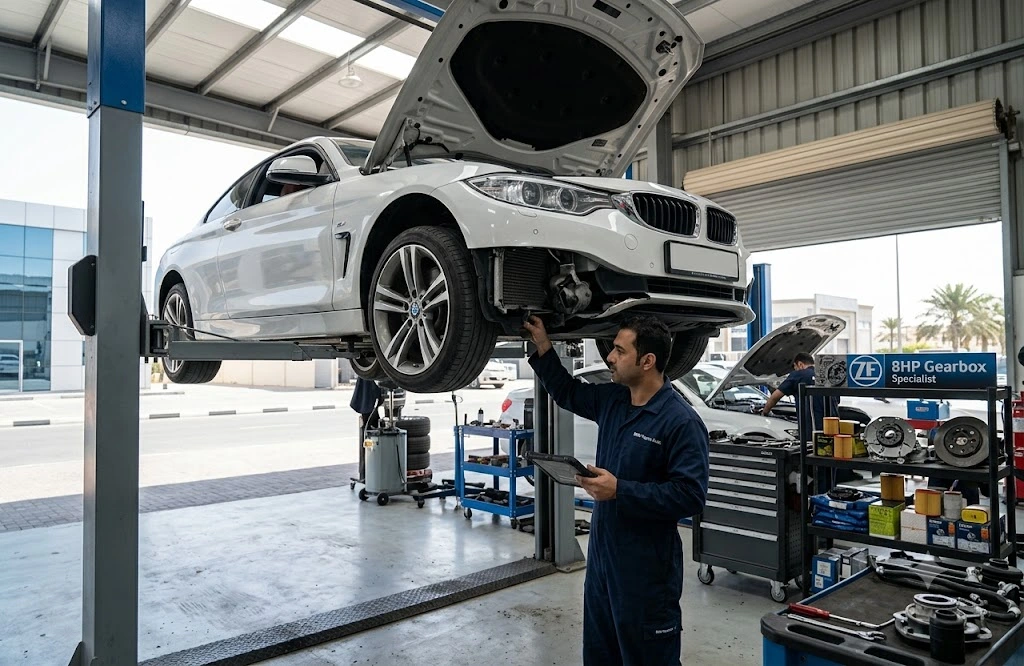
Every model has a personality, and the 4 Series is no exception. These are the faults that come through our doors most often, why they happen, and what a proper repair looks like rather than a temporary patch.
01 — Cooling system
Water Pump, Thermostat and Expansion Tank Failure
This is the single most common serious fault we handle on the F32/F33/F36 platform, and it is heavily accelerated by UAE conditions. The electric water pump is a controlled, motor-driven unit rather than a simple belt-driven pump, and its internal electronics degrade when they spend years operating at high ambient temperature. The plastic expansion tank and thermostat housing become brittle and crack, usually along a seam, and the coolant loss is slow enough that owners miss it until the temperature gauge climbs.
The warning signs are subtle at first: a sweet smell after parking, a faint crust of dried coolant on the underside of the tank, the cabin fan blowing lukewarm on heat setting, or a "coolant level low" message that returns after topping up. Ignoring it on a turbocharged BMW is expensive — an overheated aluminium head can warp, and that turns a manageable repair into a rebuild.
We pressure-test the system cold and hot, check the pump's electrical command through the DME, and when we replace, we replace the group: pump, thermostat, and any brittle plastic in the same circuit. Doing one part and leaving a nine-year-old tank next to it simply guarantees a return visit.
02 — Oil leaks
Valve Cover, Oil Filter Housing and Oil Pan Gaskets
BMW's rubber and composite gaskets are engineered for a European temperature cycle. In Dubai they live between a 45°C ambient soak and a fully heat-soaked engine bay, and they harden years earlier than the design intent. The two usual culprits are the valve cover gasket and the oil filter housing gasket. When the filter housing gasket fails, oil often runs down onto the belt or drips onto the exhaust, producing that burnt-oil smell at traffic lights and a faint smoke wisp from under the bonnet.
Left alone, oil contaminates the serpentine belt, degrades rubber mounts and coolant hoses nearby, and gradually drops your oil level between services. We clean the area, dye-test where the source is ambiguous, and reseal with correct-spec gaskets and torque values. On higher-mileage cars we usually recommend addressing the belt and any oil-soaked hoses at the same time — the labour overlaps, so it costs far less to do together.
03 — Carbon build-up
Intake Valve Carbon on Direct-Injection Engines
The N20, N26, B48 and B58 engines all use direct injection, which means fuel is sprayed into the cylinder rather than across the back of the intake valve. Nothing washes the valve, so oil vapour from the crankcase ventilation system bakes onto it and hardens. Over time the deposit restricts airflow and disturbs the intake charge.
Owners describe it as the car "feeling lazy" — a rough cold start, a slight shudder at idle, hesitation when you ask for a quick overtake, occasional misfire codes, and creeping fuel consumption. Dubai's stop-start traffic makes it worse because short, low-load journeys never get hot enough to burn deposits off.
The proper fix is walnut blasting: removing the intake manifold and media-blasting the valves clean. It is a physical cleaning job, not a fuel additive, and the difference in throttle response afterwards is immediately obvious. We typically recommend inspecting at around 80,000–100,000 km on these engines.
04 — Turbo & boost
Turbocharger, Wastegate Rattle and Charge-Pipe Leaks
The N55 and B58 are strong engines, but the wastegate actuator linkage can develop play, producing a metallic rattle at light throttle that sounds alarmingly like a loose heat shield. On four-cylinder cars, the plastic charge pipe between the intercooler and throttle body is a known weak point — it splits, and you get a sudden loss of power with a "drivetrain malfunction" message and a whooshing sound under acceleration.
We diagnose these with live boost-pressure data rather than by ear alone, comparing requested against actual boost across the rev range. A split pipe is a quick, inexpensive fix if caught early; a genuinely failing turbo needs a decision about rebuild versus replacement, and we will show you the oil-feed condition and shaft play before you spend anything.
05 — Transmission
ZF 8HP Gearbox Harshness and Mechatronic Faults
The ZF eight-speed automatic in the 4 Series is one of the finest gearboxes ever fitted to a road car — when it is looked after. BMW's "lifetime fluid" claim is the source of most of the trouble we see. In UAE heat, transmission fluid oxidises faster, and degraded fluid causes the exact symptoms owners report: a jerk between second and third, delayed engagement when shifting from P to D, flaring under moderate load, or an occasional hard downshift when slowing for a signal.
The mechatronic unit's sleeve and adapter seals also leak, and because the fluid is inside a sealed pan, a slow loss goes unnoticed until shift quality collapses. For BMW 4 Series gearbox repair Dubai work we start with a fluid and pan service, valve body inspection and adaptation reset. That resolves a large share of cases at a fraction of the cost of a replacement box — and when a deeper rebuild genuinely is needed, we tell you plainly rather than starting with the most expensive option.
06 — Air conditioning
Weak AC, Slow Cooling and Compressor Failure
An AC system in Dubai does several times the work it would do in Munich. On a 4 Series that means the compressor, condenser and expansion valve are under continuous load for most of the year, and the condenser sits at the front of the car where it collects fine desert dust that insulates it and destroys efficiency.
Typical complaints: cold at speed but warm in traffic, cooling on one side only in the dual-zone system, a musty smell from the vents, or a clicking compressor clutch. We test refrigerant pressure on both high and low sides, check condenser airflow and cleanliness, verify the auxiliary fan is commanding correctly, inspect the cabin filter and evaporator, and use UV dye tracing to find slow leaks rather than simply re-gassing a system that will empty again in two months.
07 — Suspension
Control Arms, Bushes, Struts and Run-Flat Damage
The 4 Series rides on a sport-tuned chassis with firm bushes and, on many cars, run-flat tyres. That combination transmits impact energy straight into suspension components. Dubai's main roads are excellent, but community roads, speed cushions, unmarked ramps and construction detours deliver the sharp vertical hits that kill bushes and top mounts.
Symptoms include a knock over expansion joints, vague steering that wanders slightly on the highway, uneven inner tyre wear, or a steering wheel that no longer self-centres cleanly. We inspect on a lift with the load off the suspension, check for torn bushes and leaking dampers, and always finish with a four-wheel alignment — replacing arms without aligning afterwards is a wasted repair.
08 — Electrical
Battery Drain, Sensors, iDrive and Module Faults
Modern BMWs are networked cars with dozens of control modules talking constantly. Heat is hard on batteries — a battery that would last five years in a mild climate often gives three here — and a weak battery produces bizarre, unrelated-looking faults: parking sensors that fail intermittently, a frozen iDrive screen, false airbag or ABS warnings, or start-stop refusing to engage.
Two things matter here. First, correct diagnosis using BMW-specific software that reads every module, not a generic OBD reader that only sees basic engine codes. Second, correct battery registration: replacing a battery without coding it to the car means the charging system keeps using the old profile and the new battery is quietly overcharged. We do both as standard.
09 — Brakes
Warped Discs, Sensor Warnings and Rapid Pad Wear
Dubai driving is a brake-heavy pattern: sustained speed on Sheikh Zayed Road followed by heavy deceleration, then long crawls in dense traffic. Repeated high-energy stops overheat discs, and the result is a pulsing pedal and a shimmy through the steering wheel at highway speeds. The brake pad wear sensor also has a habit of triggering earlier than owners expect on performance-specification cars.
We measure disc thickness and run-out rather than eyeballing them, check caliper slide pins for heat-seized movement, inspect fluid moisture content — brake fluid absorbs water and boils sooner, which is exactly what you do not want on a hot descent — and fit pad and disc combinations matched to how you actually drive the car.
10 — Convertible roof
F33 and G23 Roof Mechanism Faults
Convertible owners get an extra system to look after. The F33's folding hard top uses hydraulic rams and a chain of microswitches; the G23's fabric roof uses electric motors and cables. Both rely on every sensor agreeing that the previous stage completed before moving to the next. One dirty or misaligned switch stops the whole sequence and leaves the roof half-open — usually at the worst possible moment.
Heat also hardens roof seals, so water finds its way in during the rare heavy rain and pools in the boot or footwell. We service the mechanism properly: clean and lubricate the rams and pivots, test each sensor's signal, check hydraulic pressure and reservoir level, clear the drainage channels, and recondition the seals.
11 — Fuel & ignition
High-Pressure Fuel Pump, Injectors and Coils
Misfires on a 4 Series are usually one of three things: a failing ignition coil, a leaking injector, or a high-pressure fuel pump losing rail pressure. The symptoms overlap — rough idle, a flashing engine light, a shaking start — so guessing is expensive. Heat and fuel quality both accelerate coil breakdown, and coils tend to fail as a batch rather than individually.
We identify the exact cylinder from live misfire counters, test rail pressure under load, and check injector correction values before replacing anything. If one coil has failed at 90,000 km, we will tell you honestly that the other three are likely close behind so you can decide whether to do them together.
12 — Warnings
"Drivetrain Malfunction" and Limp Mode
Few messages worry owners more than "Drivetrain Malfunction — Drive Moderately." It is not a specific fault; it is the car telling you it has detected something outside expected parameters and has reduced power to protect itself. On the 4 Series the underlying cause is most often a boost leak, a failed coil or injector, a faulty sensor, or a fuel delivery problem.
The important point is that the message stores a fault memory. Even if the car drives normally after a restart, the record is there, and reading it properly is how we find the real cause. Please do not let anyone simply clear the code and hand the car back — that is deleting evidence, not fixing a car.