
BMW Coolant Leak: Water Pump, Expansion Tank & Hose Failures Explained
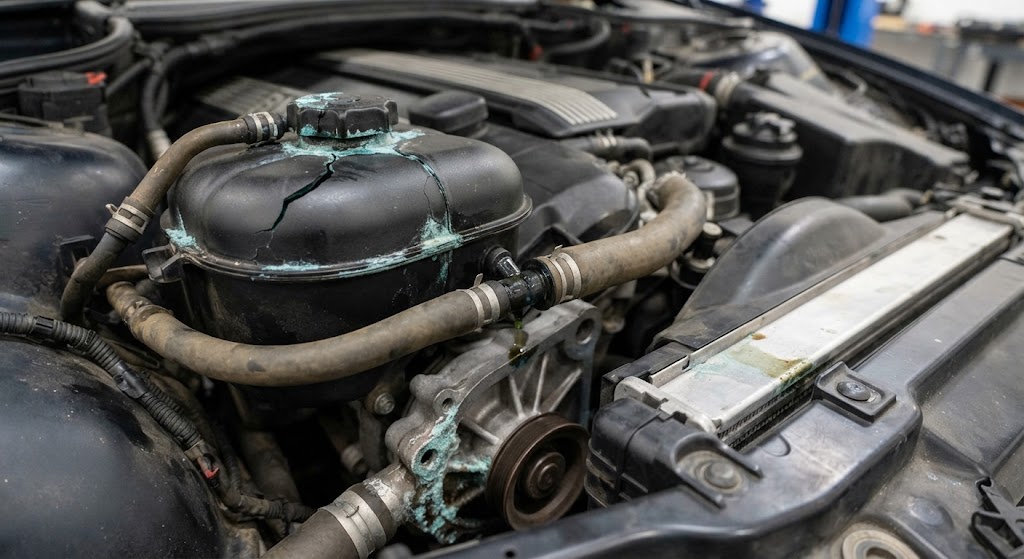
Halfway through a slow crawl home on Sheikh Zayed Road, a 'Coolant level too low' message pops up on your BMW's dashboard. The next morning there's a blue-green stain on the car-park floor under the front bumper, and a faintly sweet smell lingers around the bonnet.
A BMW coolant leak most often comes from the plastic expansion tank, the water pump, the thermostat housing, the radiator or a cracked hose quick-connect fitting. Look for coloured drips, dried crust and a sweet smell, keep the level topped up with BMW-approved coolant, and have the system pressure-tested before the engine overheats.
Signs your BMW has a coolant leak
A BMW coolant leak rarely starts with a dramatic gush. Most begin as a slow weep that evaporates off hot metal, so the first clue is usually a dashboard message rather than a puddle.
- A low-coolant message or the BMW coolant light. A level sensor in the expansion tank triggers it when the level drops below minimum. If it returns soon after a top-up, coolant is escaping somewhere.
- Coloured drips under the front of the car. BMW coolant is usually blue or blue-green and feels slightly slippery between your fingers.
- A sweet, syrupy smell from the engine bay after a drive, or from the air vents.
- Dried crust on engine parts. Evaporated coolant leaves a chalky white, blue or greenish residue that often marks the exact leak point.
- Steam from under the bonnet when you stop, usually near the front of the engine.
- A greasy film inside the windscreen, which points towards the heater core.
- A red temperature warning or reduced power, meaning the level is already low enough to cause overheating.
Clear water dripping from under the car after a drive with the AC running is normal condensation from the air-conditioning drain. It has no smell and dries without a mark. Coolant is coloured, smells sweet and leaves a crusty ring, so dab any puddle with white tissue to tell them apart.
Where BMWs usually leak coolant
A BMW cooling system runs under pressure and relies on plastic housings, rubber hoses and O-ring seals, so every joint is a possible exit point. Here is where our technicians find leaks most often.
Expansion tank
The expansion tank is a translucent plastic reservoir holding reserve coolant and the level sensor. A BMW expansion tank leak usually comes from a hairline crack along the moulded seam, a split hose nipple or, on many models, a cracked plastic bleed screw. A worn cap seal can also let coolant escape as vapour, so we test the cap separately.
Water pump
Many N-series petrol engines use an electric main water pump, while most diesels and many newer B-series engines use a belt-driven mechanical one. A BMW water pump leak on a mechanical pump shows as crust or wetness at the weep hole, sometimes with a whine or a wobbly pulley. In our workshop, electric pumps more often fail electronically, though their seals can weep too.
Thermostat housing
The plastic thermostat housing, which on many petrol models holds an electronically controlled thermostat, can crack or distort with age, and its gasket can fail. Coolant then runs down the front of the engine and gets blamed on the water pump, so we clean the area and pressure-test before deciding which part is at fault.
Radiator
Most BMW radiators combine an aluminium core with crimped-on plastic end tanks. The seams seep, the tanks crack, and the hose necks are a frequent weak spot. Expect a stain directly under the front bumper and crust along the side tanks.
Hoses and quick-connect fittings
Many BMW coolant hoses clip onto pipes with quick-release connectors sealed by O-rings. With age the O-rings harden, clips weaken and plastic connector necks crack, especially on the radiator hoses and the small vent hose to the expansion tank. Squeeze hoses with the engine cold: a crunchy or spongy feel means replacement is due.
Heater core
The heater core is a small radiator behind the dashboard that stays in the cooling circuit even if you rarely use heat. Leaks bring a sweet cabin smell, a misty windscreen and a damp front footwell. A blocked AC drain can also wet the carpet, so the smell and fluid colour help tell them apart.
Coolant pipes under the intake (V8 engines)
V8 engines carry extra coolant pipework in the valley between the cylinder banks. On the N62, a transfer pipe under the intake manifold relies on rubber seals that harden with age; on the twin-turbo N63, the turbos sit in that valley and bake nearby hoses. Leaking coolant pools there and drips from the back of the engine, where it is easily mistaken for a gearbox leak.
How our technicians trace a BMW coolant leak
Guesswork gets expensive, so our diagnosis follows a set routine:
- Read fault codes and the stored check-control messages.
- Inspect the engine cold, with the car raised and underbody panels removed.
- Pressure-test the system and the cap to working pressure.
- Add UV dye for slow leaks and inspect again after a drive.
- Look for signs of internal loss if nothing shows externally.
Why plastic cooling parts fail faster in the UAE
BMW uses glass-fibre-reinforced plastic for tanks, housings and connectors because it is light and doesn't corrode. The trade-off is heat ageing: every warm-up and cool-down makes it expand and contract, and over the years it turns brittle.
UAE driving speeds this up. With summer temperatures above 45°C, the engine bay starts hot, stop-start traffic cuts airflow through the radiator, and the AC condenser in front adds heat. Once you park, heat soaks through the engine bay with no airflow at all.
Fine sand and dust pack into the radiator fins and reduce cooling, while rubber hoses and O-rings harden faster. On cars here, a BMW coolant leak usually traces back to tired plastic or rubber, which is why our technicians inspect these parts at every service.
Check the coolant level monthly in summer, first thing in the morning when the engine is cold. Ask for dust to be cleared from the radiator and condenser fins at each service, and park in shade where you can.
'Coolant level too low' warning: what to do
The BMW coolant level too low message means the level sensor in the expansion tank has detected a drop below minimum. It isn't an overheating warning yet, but don't ignore it. In general, a yellow coolant message relates to level, while red means the engine is already too hot.
If it appears while driving
- Check for a red temperature warning, steam or reduced power. If you see any of them, pull over safely and switch off.
- If only the level message is showing, drive gently to a safe place and switch the AC off to ease the load on the cooling system.
How to check and top up safely
Let the engine cool completely, which can take a couple of hours after a summer drive. Open the cap slowly under a cloth, check the level against the marks shown in your handbook, and top up only with BMW-approved coolant mixed 50:50 with distilled water, or an approved premix.
Never open the cap on a hot engine. The system is pressurised, and coolant above boiling point can spray out and cause serious burns.
Note how much you add and how often, as it shows how fast coolant is escaping. Large top-ups also trap air, and many BMWs need a specific bleeding routine to purge it, because a leftover air pocket can cause hot spots.
Coolant warning keeps coming back?
Our technicians pressure-test your BMW's cooling system to pinpoint the leaking tank, hose, pump or pipe, then quote for that exact repair before any work starts. Send us your model and a photo of the warning or the drip.
Which coolant does a BMW need?
The correct BMW coolant type is a BMW-approved antifreeze mixed with distilled or deionised water, normally 50:50. BMW's formula is free of phosphates and nitrites and is designed to protect the aluminium engine and radiator from corrosion.
Antifreeze matters even where it never freezes, because it raises the boiling point and carries the corrosion inhibitors. Genuine BMW coolant is blue, but colour is only dye, so choose by the approval on the label.
Don't mix coolant types. Different inhibitor chemistries can react, weakening corrosion protection and sometimes forming sludge that blocks the radiator and heater core. Plain tap water is no substitute either: it dilutes the protection, lowers the boiling point and can leave mineral deposits. Distilled water will get you to a workshop in an emergency, but correct the mix soon after.
BMW coolant leak repair cost in Dubai
Cost depends mainly on which part is leaking and how much must come off to reach it. An expansion tank is quick to change; V8 pipes under the intake can take most of a working day.
| Leak location | Typical signs | Approximate cost (AED) |
|---|---|---|
| Expansion tank or cap | Crust on tank, low-level warning, hiss when hot | 450–1,200 |
| Hose or quick-connect fitting | Wet hose ends, cracked clip, drip under engine | 300–1,000 |
| Thermostat housing | Wetness at front of engine, unstable temperature | 700–2,000 |
| Water pump (mechanical or electric) | Crust at weep hole, pump noise, pump fault warning | 1,000–4,000 |
| Radiator | Stain under front bumper, crust on side tanks | 1,000–2,800 |
| Heater core | Sweet cabin smell, misty windscreen, damp footwell | 2,000–6,000 |
| V8 coolant pipes under intake | Coolant in engine valley, drips at rear of engine | 2,500–7,000 |
| Leak diagnosis and pressure test | Warning but no visible leak | 150–400 |
| Coolant flush and refill | Old, dirty or mixed coolant | 350–800 |
Prices are approximate and vary by model, engine, condition and parts option (genuine, aftermarket or used). Contact us for an exact quote.
A proper quote includes fresh coolant and bleeding the system. We source genuine, aftermarket or used parts, but rarely recommend used plastic cooling parts because they have already endured years of heat cycles.
If your BMW is still under warranty or a service contract, check its terms before booking any repair. In-warranty repairs and recalls are normally handled by the authorised dealer.
Can you drive with a BMW coolant leak?
It depends on how quickly coolant is escaping and what the dashboard shows. Many BMWs have no conventional temperature needle, so a red warning may be your first sign of overheating.
A short, careful drive is usually fine if:
- The level stays above minimum between checks.
- The level message clears after a top-up with the correct coolant.
- You're heading straight to a workshop and watching the dashboard.
Stop and arrange recovery if:
- A red temperature warning appears or the car reduces power.
- You see steam or coolant pouring out.
- The level drops noticeably after one short drive.
Driving an overheating engine risks a warped aluminium cylinder head or a failed head gasket, turning a modest repair into a major one. If in doubt, stop.
Frequently Asked Questions
Why does my BMW keep losing coolant with no visible leak?
Most often, the leak is small enough to evaporate on hot engine parts before it can drip. Underbody panels also catch and hide drips, and a worn expansion tank cap can let coolant escape as vapour. Less often, the heater core is leaking inside the dashboard or coolant is being lost internally. A pressure test, a cap test and UV dye normally reveal the source without guesswork.
Is it safe to drive with the BMW coolant light on?
Only for a short, gentle drive, and only if it is the low-level message and the engine temperature is normal. Top up with the correct coolant once the engine is cold, then have the system checked. If the warning is red, or you see steam or the car reduces power, stop as soon as it is safe and switch off, because continuing can damage the cylinder head.
Where is the most common BMW coolant leak?
In our workshop, the plastic expansion tank and the hose quick-connect fittings are among the most frequent culprits, along with water pumps, thermostat housings and radiator end tanks. All of these use plastic or rubber that ages with heat cycles. On V8 models, pipes in the valley under the intake are a known weak point. The exact pattern varies by engine, which is why a pressure test matters.
What colour is BMW coolant?
Genuine BMW coolant is blue, and a leak often leaves a blue or blue-green stain or crust. However, colour is only a dye and does not tell you the chemistry, so approved aftermarket coolants may look different. If you find orange, rusty or brown coolant, it may have been mixed with the wrong type or be overdue for a change, and the system should be checked.
Can I top up my BMW with any coolant?
No. Use a coolant that carries BMW approval on the label, mixed with distilled water if it is a concentrate. Adding an unapproved or different type can weaken the corrosion protection and, in some combinations, form sludge. If you are stuck, a small amount of distilled water will get you to a workshop, but have the mixture tested or the system flushed soon afterwards.
How much does it cost to fix a BMW coolant leak in Dubai?
Approximately AED 300 to AED 1,200 for a hose, fitting or expansion tank, and roughly AED 1,000 to AED 4,000 for a water pump, depending on whether it is mechanical or electric. Heater cores and V8 coolant pipes cost more because of the labour involved. Prices vary by model, engine and parts option, so contact us with your car's details for an exact quote.
Why does my BMW smell sweet inside?
A sweet, syrupy smell in the cabin usually means coolant is escaping from the heater core behind the dashboard, or vapour from an engine-bay leak is being drawn in through the fresh-air intake. A greasy film on the windscreen or a damp front carpet strengthens the heater core suspicion. Coolant vapour isn't something you want to breathe for long, so have it checked promptly rather than masking the smell.
Can a coolant leak cause my BMW to overheat?
Yes. As the level falls, air enters the system and the pump can no longer move enough coolant through the engine and radiator. On a hot UAE day in slow traffic, that can happen quickly. Overheating can warp the aluminium cylinder head and damage the head gasket, so a small leak that's ignored can become a far more expensive repair.
Does a coolant leak mean a head gasket problem?
Not usually. Most BMW coolant losses we see are external leaks from tanks, hoses, pumps or housings. A head gasket or cylinder head problem becomes more likely if there's no external leak, the expansion tank bubbles with the engine running, the exhaust produces persistent white smoke with a sweet smell, or the oil looks milky. A combustion-gas test in the coolant helps confirm or rule it out.
How often should BMW coolant be changed?
Our technicians suggest renewing BMW coolant roughly every three to four years in UAE conditions, because heat steadily uses up its corrosion inhibitors. BMW's own guidance varies by model, and the service display may not show a coolant change at all, so check your owner's handbook too. Refresh it sooner if the coolant looks dirty or mixed, and whenever a major cooling part is replaced.
Find the source of your BMW coolant leak before the engine overheats
From a cracked expansion tank to a seeping V8 coolant pipe, our technicians pressure-test the system, show you what has failed and explain the fix in plain English. Call or WhatsApp us with your model and the warning you're seeing for a clear, upfront quote.