
Are BMW Oil Leaks Common? Causes, Warning Signs & Repair Cost in Dubai
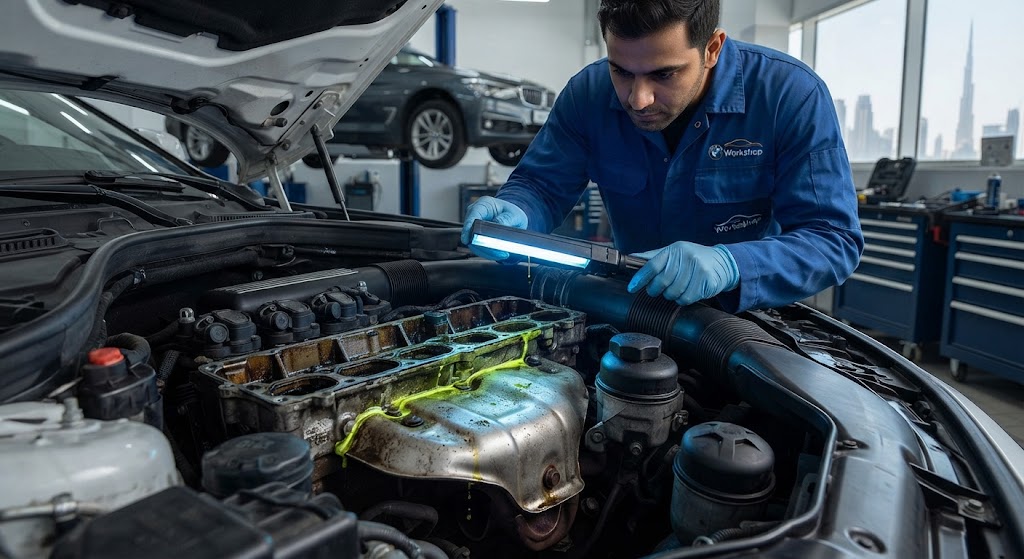
Yes — the honest answer to “are BMW oil leaks common” is that many BMWs develop a gasket or seal leak as they age, because rubber hardens after years of heat cycles. In the UAE, where summers pass 45°C and engines idle for long spells in traffic, that happens sooner, so it pays to know the usual leak points, warning signs and real repair costs.
Yes. Oil leaks are among the most common faults on BMWs older than five years. The usual sources are the valve cover, oil filter housing and oil pan gaskets, which harden faster in UAE heat. Most start as slow seeps, but oil reaching the drive belt or exhaust should be repaired promptly to avoid belt failure or fire risk.
Do all BMWs leak oil?
No BMW leaves the factory leaking, and many well-kept cars stay dry for years. Leaks appear once the rubber gaskets and seals have been through thousands of heat cycles and lost their flexibility. In our workshop, most leaking BMWs are past five years old, and the leak usually starts as a damp, dusty film rather than a drip.
Are BMW oil leaks common on every model?
They affect four-cylinders, straight-sixes and V8s alike, but some engines have a stronger reputation. The N20 four-cylinder, the N52 and N55 straight-sixes and the twin-turbo N54 are well known for valve cover and oil filter housing seepage. The N63 V8 places its turbochargers inside the V of the engine, so any oil escaping there lands on very hot metal.
Do BMWs leak oil more than other cars?
Not dramatically, compared with similar European cars. What makes BMW leaks noticeable is where the oil lands: the exhaust manifold often sits just below the valve cover's edge, and the drive belt runs close to the oil filter housing. Many BMW engines also use an electronically controlled thermostat that lets them run warmer at light loads, so the seals spend much of their life hot.
So, are BMW oil leaks common on low-mileage cars? Less so, but age matters as much as distance: several summers in open parking can harden the seals on a car that rarely moves.
Why heat makes BMW gaskets fail sooner in the UAE
The climate is a big part of why “are BMW oil leaks common” is such a frequent question from UAE owners. Rubber is the weak link in any sealing system, and heat is what ages rubber.
Rubber hardens and stops pushing back
A gasket seals by being squeezed between two surfaces and pushing back against them. Sustained heat hardens the rubber and leaves it permanently flattened, which technicians call compression set. Once that happens, tiny gaps open up and oil finds its way through.
Stop-start traffic and heat soak
Rush-hour crawling with the AC working hard cuts airflow through the engine bay while the condenser adds heat in front of the radiator. After you switch off, heat from the exhaust and turbo rises into everything above it; repeat that daily in a sun-baked car park and seals age faster than in a cooler climate.
Mixed materials and blocked ventilation
Aluminium cylinder heads and plastic valve covers expand at different rates, so every heat cycle shifts the joint slightly and older covers can warp or crack. On many BMWs the crankcase ventilation valve is built into that cover, venting gases that slip past the pistons. If its diaphragm splits or the system clogs, pressure builds inside the engine and pushes oil out through the weakest seal.
Sand and dust hide the evidence
Fine dust sticks to oily surfaces, forming a dark crust that exaggerates a small seep and hides its source. That's why our technicians clean the engine before diagnosing rather than guessing from the dirtiest area.
The 6 most common BMW oil leak points
Are BMW oil leaks common everywhere on the engine? No. They cluster around six seals, and where each sits explains why repair times vary so much.
1. Valve cover gasket
The valve cover sits on top of the cylinder head and is plastic on most modern BMWs. A BMW valve cover gasket leak shows as oil along its edge, often on the exhaust side, where drips hit the manifold and cause smoke and a burning smell.
On many engines the gasket set includes the spark plug tube seals; when they fail, oil pools around the plugs and soaks the ignition coils, causing misfires. Our technicians check the cover for cracks and test the ventilation valve to decide whether a gasket is enough or the whole cover needs replacing.
2. Oil filter housing gasket
Most modern BMW petrol engines use a top-access oil filter housing bolted to the side of the block, often carrying the oil cooler connections. A BMW oil filter housing gasket leak sends oil down onto the drive belt and pulleys, which is why we treat it as the most urgent of the common leaks.
Fixing it means renewing the housing gasket and oil cooler seals, plus the belt if it has absorbed oil. First, though, rule out a reused or pinched O-ring on the filter cap, which leaves a similar wet trail.
3. Oil pan gasket
The oil pan, or sump, is the reservoir at the bottom of the engine. A failing gasket leaves drips under the front of the car and a soaked undertray, but our technicians check the drain plug washer first, since it's a cheap fix with similar symptoms.
When the pan gasket itself has failed, labour is the main cost. On many six-cylinder and xDrive models the front subframe or steering parts must be lowered to remove the pan, and aluminium bolts, where fitted, are replaced rather than reused.
4. Vacuum pump seal
Your brake servo needs vacuum, but turbocharged, Valvetronic and diesel engines produce little of it, so BMW fits a mechanical vacuum pump lubricated by engine oil. Its gasket or O-ring hardens like any other seal, leaving fresh oil around the pump body; the N20 is one engine where technicians regularly find this seep.
A seal leak alone doesn't affect braking, but a brake pedal that suddenly feels hard suggests the pump itself is failing and needs urgent attention.
5. Turbo oil feed and return lines
Turbocharger bearings are fed by a pressurised oil line and drained by a return line, both sealed with gaskets, O-rings or crush washers beside the hot turbine housing. When those seals harden, oil weeps onto the turbo and exhaust, producing smoke and a sharp burning smell.
Twin-turbo engines such as the N54 and N63 have more lines and tighter access, raising the labour. Heavy oil inside the intake pipes is a separate fault, involving the turbo's internal seals or crankcase ventilation.
6. Rear main seal
This seal surrounds the back of the crankshaft where the engine meets the gearbox, so a leak drips from that joint, further back than an oil pan leak. Replacing it means removing the gearbox, which puts it at the top of the price range.
Oil from a valve cover or oil pan leak can run back to the same spot, so our technicians confirm the source with UV dye first, and a very light seep with a stable oil level is sometimes simply monitored.
Warning signs of a BMW oil leak
Most owners who ask us “are BMW oil leaks common?” have already noticed one of these signs:
- Burning oil smell, strongest after stopping in traffic; fumes can enter through the cabin's fresh-air intake below the windscreen.
- Thin blue-grey smoke from under the bonnet at idle, as oil cooks on the exhaust or turbo.
- Dark brown or black spots where you park, slippery between your fingers.
- Oil level messages, or needing to top up between services.
- A damp, dusty crust around the valve cover edge, filter housing or sump.
- A squealing or frayed drive belt, often linked to a filter housing leak.
- Misfires or an engine warning light caused by oil in the spark plug wells.
Checking the oil level without a dipstick
Many modern BMWs have no dipstick. An electronic sensor measures the level instead, shown in the iDrive menu or instrument cluster; your handbook lists the exact steps, usually with the car level and the engine warm.
If you suspect a leak, check every couple of weeks; the rate of loss shows how urgent the repair is.
Clear water dripping under the front of the car on a hot day is condensation from the air-conditioning and is normal. To check for a real leak, park overnight in a shaded spot with clean cardboard under the engine and look at the marks in the morning: engine oil is brown to black, while coolant is thinner, sweet-smelling and usually blue or green.
If smoke rises from under the bonnet or a red oil pressure warning appears, pull over safely and switch off the engine. If you see flames, don't open the bonnet: move well away from the car and call Civil Defence on 997 or the police on 999.
Burning oil smell or fresh drips on your parking spot?
Our technicians clean the engine, trace the leak with UV dye and show you which seal has failed, whether valve cover, filter housing, sump or turbo line, before quoting. Send a photo of the leak on WhatsApp or call to book an inspection.
Why you shouldn't ignore an oil leak
Even a seep that barely moves the oil level deserves attention, because the real problem is where the oil goes and what it damages.
Belt damage from an oil filter housing leak
Drive belts aren't designed to sit in oil. As it soaks in, the belt softens and slips, then cracks and frays. On most BMWs the belt drives the alternator and AC compressor, so losing it means no charging and no air conditioning in mid-summer.
There's a bigger risk on some engines: belt shreds can be pulled behind the crankshaft pulley and damage the front crankshaft seal, turning a slow seep into sudden, heavy oil loss.
If the filter housing area is wet and the belt looks glazed, cracked or frayed, have the gasket and belt replaced together before any long highway drive. An oil-soaked belt can't be cleaned back to health.
Oil on the exhaust and fire risk
Exhaust manifolds and turbochargers run far hotter than the temperature at which engine oil can ignite. Most drips burn off as smoke, but oily dust collecting on heat shields or in the undertray can eventually catch fire, especially when hard driving is followed by idling.
Damage to rubber, coils and wiring
Oil softens engine mounts, coolant hoses and wiring insulation beneath a leak, and oil in the plug wells damages ignition coils. All of these cost far more to replace than the original seal.
Low oil and internal wear
BMW engines rely on steady oil pressure for VANOS camshaft timing, the timing chain tensioner and, on turbo engines, the turbo bearings. A leak plus normal consumption can drop the level faster than expected, and hardened gaskets never recover, so the seep only grows.
BMW oil leak repair cost in Dubai
Once the answer to “are BMW oil leaks common” sinks in, cost is the next question. Anyone wondering how much to fix a BMW oil leak should know the gasket itself is usually cheap; the bill is mostly labour, set by how much must come off the engine to reach the seal.
| Leak point | Common signs | Approximate cost (AED) |
|---|---|---|
| Valve cover gasket and spark plug tube seals | Oil along the top edge of the engine, burning smell, misfires | Approx. 600–1,600 |
| Valve cover replacement (cracked cover or failed ventilation valve) | Whistle at idle, rising oil use, visible cracks | Approx. 1,800–4,500 |
| Oil filter housing gasket | Oil on the belt and pulleys, belt squeal | Approx. 900–2,500 |
| Oil pan gasket | Drips under the front of the car, soaked undertray | Approx. 1,500–4,500 |
| Vacuum pump seal | Fresh oil around the pump body, burning smell | Approx. 600–1,800 |
| Turbo oil feed and return lines | Smoke near the turbo, sharp burning smell | Approx. 1,000–3,800 |
| Rear main seal | Drips at the engine-to-gearbox joint | Approx. 2,500–6,500 |
| Leak inspection with cleaning and UV dye | Source unclear or several wet areas | Approx. 200–450 |
Prices are approximate and vary by model, engine, condition and parts option (genuine, aftermarket or used). Contact us for an exact quote.
Are BMW oil leaks expensive to fix?
Most aren't, if caught early. Costs rise with difficult access, such as an oil pan on an xDrive model, turbo lines on a V8 or a rear main seal that needs the gearbox out, and when a neglected leak has already ruined the belt or coils.
We source genuine, aftermarket and used parts, but for gaskets we usually recommend genuine or high-quality aftermarket seals: the labour is identical, so a cheap gasket that fails early means paying it twice.
If your BMW is still under manufacturer warranty or a service contract, check its terms before booking independent work. In-warranty repairs and recalls are normally handled by the authorised dealer.
How to reduce the chance of oil leaks
Nothing stops rubber from ageing, but you can slow it down and catch leaks while they're still cheap to fix.
Maintenance habits that protect your seals
- Use the right oil and change it sooner. Choose an oil with the BMW Longlife approval listed for your engine. In sustained heat and stop-start traffic we suggest changing it before the service indicator's maximum interval, which keeps the ventilation system cleaner.
- Renew the small seals every time. The filter cap O-ring and drain plug washer cost very little, and reusing them is a common cause of minor leaks.
- Ask for a leak check at each service. With the undertray off, a technician can spot a fresh seep long before it drips or reaches the belt.
- Fix ventilation faults early. A whistle at idle or rising oil consumption deserves attention, because excess crankcase pressure strains every seal.
Mistakes that create new leaks
- Over-tightening. Too much torque cracks plastic covers and distorts new gaskets; our technicians work to BMW's specified torque settings.
- Pressure-washing the engine bay. Water forced into connectors and coil wells can cause electrical faults on top of the leak.
Covered or shaded parking keeps the engine bay cooler after you switch off, easing heat soak on ageing gaskets. It won't cure an existing leak, but it helps delay the next one.
Are BMW oil leaks common? Yes, but they're also among the most predictable faults on the car. Know the six leak points, act quickly on a burning smell or a wet belt, and most leaks stay a routine gasket job.
Frequently Asked Questions
Are BMW oil leaks common?
Yes. Oil leaks are one of the most frequent faults on BMWs over five years old, because rubber gaskets and seals harden with heat and age. The valve cover and oil filter housing gaskets are the usual culprits. In the UAE, high temperatures and long idling in traffic tend to bring these leaks on sooner, so regular inspections help catch them early.
How much does it cost to fix a BMW oil leak in Dubai?
At an independent workshop, most BMW oil leak repairs cost roughly AED 600 to AED 2,500, and most of that is labour. Valve cover and oil filter housing gaskets sit at the lower end, while an oil pan gasket or rear main seal can reach about AED 4,500 to AED 6,500 because of the dismantling involved. These figures are approximate; an exact quote needs an inspection.
Is it safe to drive a BMW with an oil leak?
A slow seep with a correct oil level is usually safe for short trips while you book a repair. It is not safe if oil is dripping onto the exhaust or turbo, smoke appears from under the bonnet, the drive belt is oil-soaked or squealing, or a red oil pressure warning comes on. In those cases, stop driving and have the car inspected promptly.
Why does my BMW smell like burning oil?
That smell usually means oil is landing on a hot surface such as the exhaust manifold or turbocharger. Common sources are a leaking valve cover gasket, oil filter housing gasket, vacuum pump seal or turbo oil line. The smell is often strongest after stopping in traffic and can enter the cabin through the ventilation intake. Oil spilt during a recent top-up can also cause a brief smell.
What is the most common BMW oil leak?
The valve cover gasket is the leak our technicians see most often, closely followed by the oil filter housing gasket. Both are rubber seals that sit high on the engine near hot components, so they harden and lose their grip over time. The filter housing leak is usually the more urgent of the two because the oil runs onto the drive belt.
How long do BMW valve cover gaskets last?
There is no fixed replacement interval. In our experience, seepage often begins once a car passes around 80,000 to 130,000 km or six to eight years of age. Cars that idle for long periods in heat, or have a failing crankcase ventilation valve, often leak earlier. Because the gasket is replaced only when it leaks, a visual check at each service is the best guide.
Can an oil filter housing leak damage the engine?
Yes, indirectly. On many BMWs the leaking oil runs onto the drive belt, which softens and frays. On some engines a shredded belt can be drawn behind the crankshaft pulley and damage the front crankshaft seal, causing sudden, heavy oil loss. Running low on oil can then harm the bearings, timing chain and, on turbo engines, the turbocharger.
Do oil stop-leak additives work on BMWs?
They rarely provide a lasting fix. Stop-leak products make rubber seals swell slightly, which may slow a minor seep for a while, but they cannot repair a cracked plastic valve cover, a torn gasket or a damaged turbo line seal. They also sit outside BMW's approved oil specifications and can hide where a leak starts, so replacing the failed seal is the better option.
How do I find where my BMW is leaking oil?
Start by noting where the drips land: under the front of the engine usually points to the oil pan or filter housing, while drips further back, below the engine-to-gearbox joint, suggest the rear main seal or gearbox. Check the engine's top and sides with a torch for wet, dust-caked patches. Because oil runs down and spreads, a workshop should clean the engine and trace the source with UV dye.
Do newer BMW engines still leak oil?
Yes, they can. Newer engines such as the B48 and B58 still rely on rubber gaskets and plastic covers that age in heat, and we do see oil filter housing and valve cover seepage on them as they get older. If your BMW is still under manufacturer warranty or a service contract, check its terms first; in-warranty repairs and recalls are normally handled by the authorised dealer.
Smelling burning oil? Let our technicians find the leak
If you’ve been asking “are BMW oil leaks common” since spotting drips or smelling burning oil, our technicians can clean, dye-trace and fix the exact seal that has failed on your petrol or diesel BMW. Send your model and a photo of the leak on WhatsApp, or call us, for an approximate quote before you book.