
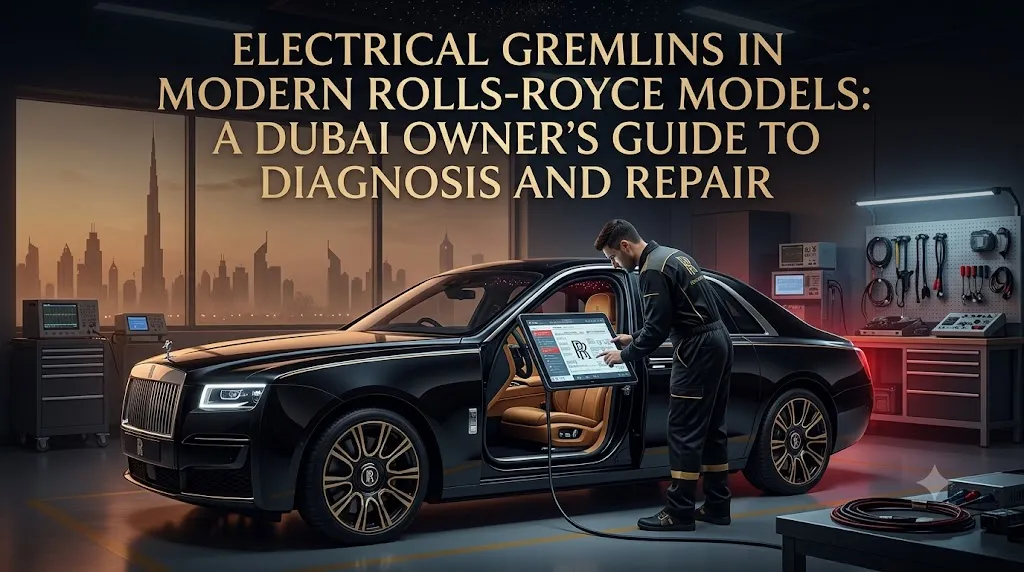
A modern Rolls-Royce is, in a very real sense, a rolling data centre upholstered in leather. The current Phantom, Ghost, and Cullinan carry dozens of electronic control modules connected by multiple communication networks, managing everything from the Starlight Headliner and self-closing doors to the adaptive suspension and driver assistance systems. When this electronic ecosystem is healthy, the car feels like sorcery. When something in it fails, the symptoms can be baffling — and in the Gulf climate, electrical faults are among the most common issues owners face.
This guide explains why electrical problems are so prevalent in the UAE, which systems fail most often, and why proper diagnosis is a skill entirely different from conventional mechanical repair.
Why Dubai Is Tough on Vehicle Electronics
Three environmental factors conspire against automotive electronics here.
Heat. Electronic components age according to temperature. Cabin interiors parked in direct sun can exceed 80°C; under-bonnet temperatures go higher still. Capacitors dry out, solder joints fatigue through expansion cycles, and plastic connector housings become brittle and lose their grip on terminals. A module that would run twenty years in London may develop faults in ten in Dubai.
Humidity and salt. Coastal humidity carries salt. Over years, it finds its way into connector bodies and earth points, creating the thin corrosion films responsible for the most maddening category of fault: the intermittent one that vanishes whenever the car visits a workshop.
Battery stress. Heat is the number-one killer of lead-acid batteries, and a modern Rolls-Royce is exceptionally sensitive to battery condition. Dozens of modules draw current even while parked, and the sophisticated power management system reacts to marginal voltage by shutting down comfort functions in ways that mimic serious faults. A tired battery in a Ghost can produce a screen full of unrelated warnings — suspension, cameras, parking sensors — all of which disappear once healthy voltage is restored.
The Most Common Electrical Faults Specialists See
1. Battery and Power Management Issues
By a wide margin, the most frequent electrical complaint. Symptoms include multiple simultaneous warning messages, systems (massage seats, soft-close doors, ambient lighting) randomly unavailable, the car failing to enter sleep mode and draining overnight, or slow cranking. The correct response is not simply fitting any new battery: the replacement must meet the exact AGM specification, and it must be registered to the power management system so charging strategy is recalibrated. Skipping registration — a common shortcut in general garages — shortens the new battery’s life and perpetuates the faults.
2. Parasitic Drain
A Rolls-Royce that will not hold charge over a week of parking usually has a module that refuses to sleep. Common culprits include telematics units, aftermarket accessories wired incorrectly, door and boot control modules, and faulty comfort access antennas. Finding the offender requires a disciplined current-draw test: monitoring milliamp consumption over time while systematically isolating circuits. It is slow, methodical work — and precisely the kind of job where specialist patience pays for itself.
3. Door and Closure Systems
The self-closing doors, powered boot, and — on Phantom and Cullinan — power-assisted coach doors rely on motors, clutches, position sensors, and dedicated modules. Heat-hardened wiring in the door jambs, where the loom flexes with every opening, is a classic failure point. Symptoms range from a door that no longer soft-closes to spurious “door open” warnings while driving. Repair involves loom inspection under magnification, repair or replacement of broken conductors with correct-gauge wire and proper sealing, and recalibration of the closure system.
4. Infotainment, Screens, and Cameras
Rear-seat entertainment screens, the central display, surround-view cameras, and night vision systems all suffer in heat. Camera image distortion, screens that black out intermittently, or a spinning-logo infotainment reboot mid-journey typically trace to either failing hardware or — more often than owners expect — degraded fibre-optic and coaxial connections in the media network. Diagnosis requires equipment that can test the optical network’s signal integrity, something virtually no general workshop possesses.
5. Sensor and Driver-Assistance Faults
Radar sensors behind the front grille and ultrasonic parking sensors baked into bumpers endure both heat and sandblasting from road dust. Degraded sensors produce false collision warnings or disable adaptive cruise entirely. Replacement is straightforward; the critical step is the calibration afterwards, which demands target boards, alignment equipment, and factory software procedures.
6. The Starlight Headliner
A signature feature with a specific failure mode: individual fibre-optic strands lose brightness, or sections go dark when the light-source module or its connections degrade. Repairing it properly means accessing the headliner without damaging irreplaceable leather and Alcantara trim — as much an upholstery skill as an electrical one, and a job that should only ever be attempted by hands that have done it before.
Why Diagnosis Is Everything
The defining characteristic of Rolls-Royce electrical work is that the symptom is rarely the fault. A suspension warning can be a battery problem. A camera failure can be a connector problem two metres from the camera. A door fault can be a software problem requiring nothing more than a module update.
Proper diagnosis requires three things in combination: factory-grade diagnostic software with security access to all modules, wiring diagrams and current flow charts for the specific chassis, and an experienced technician who has seen the pattern before. Parts-cannon repair — replacing components until the symptom disappears — is ruinously expensive on a car where a single module can cost more than a small car, and it frequently fails anyway because the true cause was a connection, not a component.
This is precisely why owners are better served by a dedicated rolls royce specialist dubai than by a general luxury-car garage. Specialists work on these exact systems daily, maintain the diagnostic platforms and software subscriptions the cars require, and — crucially — know which faults are epidemic on which model years, which turns a week of exploratory labour into an hour of targeted testing.
Protecting Your Car’s Electronics: Practical Steps
Manage the battery. If the car sits for more than a week, use a manufacturer-approved intelligent trickle charger. This single habit prevents the majority of “mystery” electrical complaints.
Park smart. Shade and underground parking dramatically reduce cabin electronics temperatures. A windscreen sunshade is not beneath a Rolls-Royce owner’s dignity — it protects six-figure electronics.
Address the first fault, not the fifth. Intermittent warnings are the system telling you a connection is marginal. Early diagnosis, while the fault is simple, is always cheaper.
Keep software current. Module software updates fix known bugs and improve power management. A specialist can check and apply outstanding updates during routine service.
Avoid unqualified accessory installation. Dashcams, trackers, and tint-shop wiring jobs are a leading cause of drains and network faults. Any addition to the car’s electrical system should be installed by someone who understands its architecture.
A modern Rolls-Royce’s electronics are not fragile — they are simply engineered to fine tolerances and deserve equally fine care. In a climate as demanding as Dubai’s, the difference between an owner plagued by warning lights and an owner who never sees one usually comes down to two things: battery discipline, and choosing the right people to look after the car.