
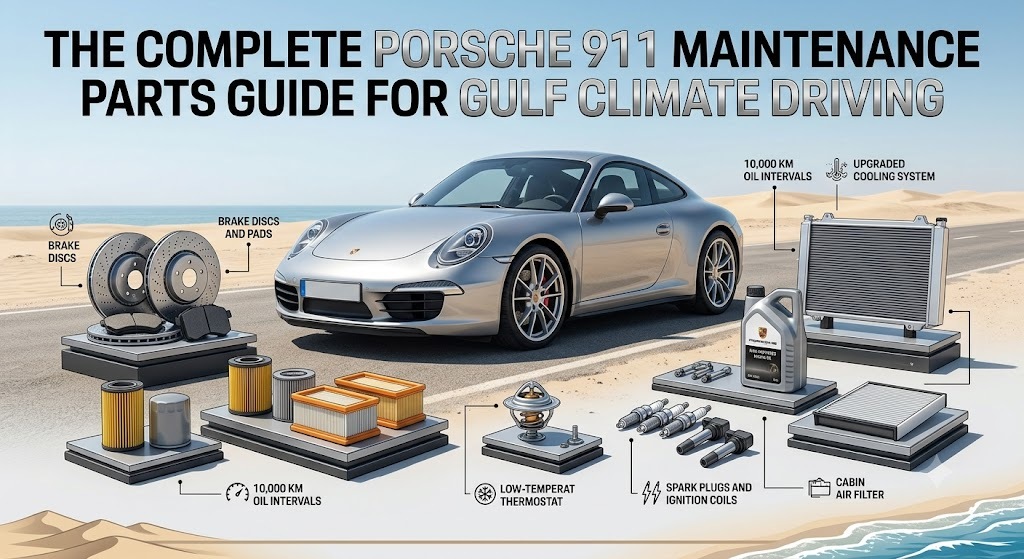
The Porsche 911 is engineered to last decades, and many examples in the UAE have covered hundreds of thousands of kilometers while still delivering the performance they left the factory with. But that longevity is not automatic — it is the product of disciplined maintenance with the right parts at the right intervals. In the Gulf, where ambient temperatures regularly exceed 45°C and fine dust penetrates everything, the standard European service schedule needs adjustment.
This guide walks through the complete maintenance parts picture for the modern water-cooled 911 — the 996, 997, 991, and 992 generations — with specific attention to what changes when your car lives in Dubai or Sharjah rather than Stuttgart.
Engine Oil and Filtration: The Foundation
Everything in 911 longevity starts with oil. The flat-six runs hot by design, and Gulf ambient temperatures push oil temperatures higher still. Two adjustments matter for UAE cars:
Shorten the interval. Porsche’s official interval of 15,000 km or one year assumes European conditions. UAE specialists widely recommend 10,000 km or six months for cars driven year-round, and even shorter for cars that see track days at Dubai Autodrome or Yas Marina.
Use the correct specification. The 911 requires oils meeting Porsche A40 approval (C40 for newer GT cars). Mobil 1, Motul, and Liqui Moly all produce approved grades. Pair every oil change with a quality filter — Mahle and Mann-Filter supply Porsche’s originals, and their branded boxes contain identical filters at lower cost.
Watch for the 996/997.1 IMS issue. Early water-cooled cars (except Turbo and GT models) used an intermediate shaft bearing that can fail. If you own a 996 or early 997 that has not had the upgraded bearing fitted, this should be your first priority. Retrofit kits are available and are typically installed during a clutch job.
Cooling System: The UAE Priority
The 911’s radiators sit in the front bumper openings, directly in the path of sand, stones, and road debris. In the UAE, three cooling components deserve proactive attention:
Radiators and condensers. Sand abrasion and corrosion from humidity eat the thin aluminum fins. Many UAE 911s need front radiators and AC condensers replaced around 100,000–130,000 km. Leaves and debris also pack between the condenser and radiator — an annual clean-out extends their life significantly.
Coolant expansion tank. A known wear item across generations. The plastic tank develops hairline cracks from heat cycling. Symptoms are slow coolant loss and a faint sweet smell in the front trunk. Replace it at the first sign — tanks are inexpensive; overheating is not.
Water pump and thermostat. The composite impeller on original water pumps can degrade. Most specialists recommend replacement every 80,000–100,000 km in Gulf conditions, together with a low-temperature thermostat for hard-driven cars.
Suspension and Steering: Feel Is Everything
The 911’s legendary steering feel depends on suspension components being in perfect condition. Heat degrades rubber bushings faster in the Gulf, so expect these intervals:
- Lower control arms (coffin arms): 60,000–80,000 km. Worn bushings cause vague steering and inner tire wear. Lemförder supplies the originals; Meyle HD versions use firmer rubber and last longer.
- Drop links and tie rod ends: 60,000 km. Knocking over small bumps is the classic symptom.
- Shock absorbers and PASM dampers: 100,000–130,000 km. Degradation is gradual, which is why owners rarely notice until new dampers transform the car.
- Engine and transmission mounts: The 911’s hydraulic engine mounts lose their damping with heat age. Increased cabin vibration at idle is the giveaway.
Brakes: Sized for the Autobahn, Worked Hard in Traffic
A 911’s brakes are enormous relative to the car’s weight, but Dubai traffic — repeated stops from 120 km/h on Sheikh Zayed Road — still wears them steadily. Standard steel brakes need:
- Pads: 30,000–50,000 km depending on driving style. Textar and Pagid supply Porsche originals.
- Discs: Usually every second pad change. Cross-drilled discs must be checked for cracking around the holes, especially on cars that see track use.
- Wear sensors and hardware: Replace with every pad change.
- Brake fluid: Every two years without exception. Humidity in the Gulf accelerates moisture absorption, which lowers the boiling point exactly when you need it most.
Cars with PCCB ceramic brakes have far longer component life but much higher replacement costs — protect the discs from kerb damage and chemical wheel cleaners.
Transmission: Manual, Tiptronic, and PDK
Manual gearboxes need fluid every 90,000 km and a clutch roughly every 80,000–120,000 km depending on traffic exposure. Stop-and-go driving is the clutch killer, and UAE cars see plenty of it.
PDK transmissions are robust but not sealed-for-life in any practical sense. Fluid and filter service every 60,000 km keeps shifts crisp. Clutch fluid (a separate circuit on PDK) follows the same interval.
Air Conditioning and Cabin Comfort
No 911 system matters more to daily usability in the Gulf. Key parts:
- AC compressor: Denso and Sanden units supply the originals. Clutch wear and refrigerant leaks are the usual failure modes.
- Condensers: As noted above, exposed and vulnerable. Nissens and Behr replacements are stocked locally.
- Cabin filter: Change every 10,000 km in the UAE, not the official 30,000 — desert dust overwhelms filters quickly, and a clogged filter strains the blower motor.
Electrical and Consumables
- Battery: Gulf heat halves battery life compared to Europe. Expect 2–3 years from an AGM battery, and replace proactively — a 911 with a dead battery locks you out of the front trunk where the battery lives (know the emergency access procedure).
- Ignition coils and plugs: Every 60,000 km. Heat-soaked coils cause the intermittent misfires that frustrate so many owners.
- Serpentine belt: Every 60,000–80,000 km. Inspect for glazing at every service.
Sourcing 911 Parts Locally
Every part mentioned in this guide is available in the UAE without dealer pricing or dealer waiting times. Established suppliers of porsche parts dubai hold local stock of 911 service items across all water-cooled generations — filters, cooling components, suspension arms, brake kits, and ignition parts — in genuine, OEM, and premium aftermarket tiers.
Owners and workshops in the northern emirates are equally well served: dealers in porsche spare parts sharjah and Dubai can cross-reference part numbers against your VIN, which is essential on the 911 given the frequent mid-generation updates Porsche applies.
A Sample UAE 911 Service Calendar
- Every 10,000 km / 6 months: Oil and filter, cabin filter, visual inspection
- Every 20,000 km: Engine air filter, brake inspection, tire rotation check
- Every 40,000 km: Brake fluid (or 2 years), full suspension inspection
- Every 60,000 km: Spark plugs, coils, PDK service, serpentine belt
- Every 80,000–100,000 km: Water pump, thermostat, coolant flush, engine mounts
Conclusion
A 911 maintained on this schedule with quality parts is one of the most reliable performance cars you can own — in any climate. The Gulf simply compresses the intervals and raises the stakes on cooling and AC health. Stay ahead of the schedule, buy parts from specialists who know the model, and your 911 will reward you with decades of the driving experience nothing else quite matches.