
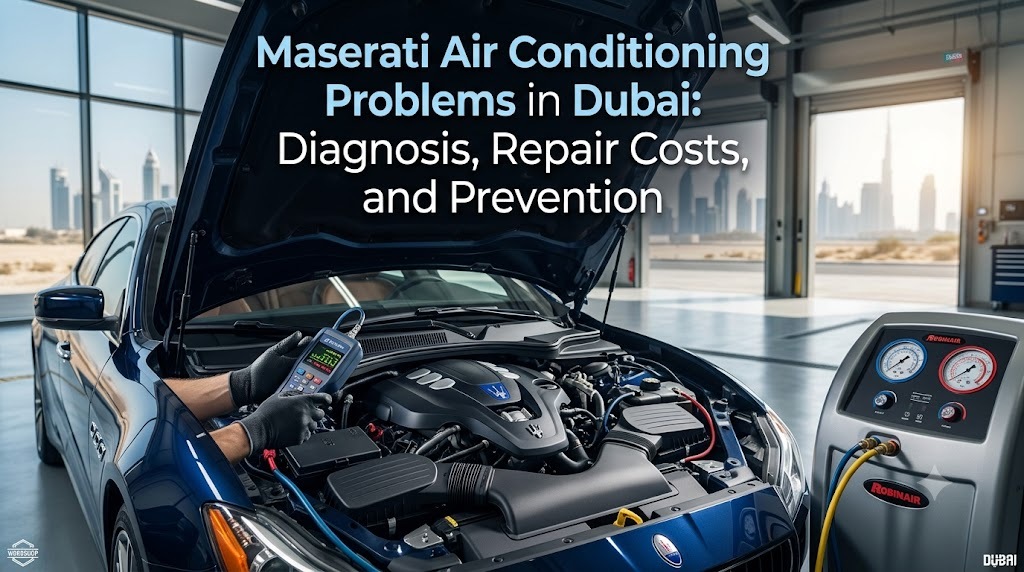
Ask any Maserati owner in the UAE what the most important system in their car is, and after a laugh about the engine, the honest answer is the air conditioning. From May to October, a Maserati with weak AC is effectively undriveable. Cabin temperatures in a car parked outdoors in Dubai can exceed 70°C, and the climate control system is expected to bring that down to 22°C within minutes — then hold it there while the condenser sits behind a grille breathing 45°C air off hot asphalt.
No AC system in any car works harder than one in the Gulf, and Maserati systems have their own specific weak points. This guide walks through how the system works, the failures we see most often on the Ghibli, Quattroporte, Levante, GranTurismo, and GranCabrio, what repairs realistically cost relative to each other, and how to keep the cold air flowing.
How Your Maserati’s AC Actually Works
Understanding four components makes every AC conversation clearer:
- Compressor — the pump, driven by the engine, that pressurises refrigerant. The hardest-working and most expensive component.
- Condenser — the radiator-like panel at the front of the car that sheds heat from the compressed refrigerant. Its efficiency depends entirely on airflow.
- Evaporator — the cold heat exchanger buried deep inside the dashboard that actually chills the cabin air.
- Blend doors and actuators — small electric motors that direct air between vents and mix hot and cold streams to hit your set temperature.
In Dubai, every one of these is pushed to its limit for most of the year.
The Five Most Common Maserati AC Failures in the UAE
1. Condenser Damage and Blockage
The condenser sits at the very front of the car, directly exposed to everything the road throws at it: sand, fine dust, stones, and construction debris. Two problems follow. First, dust and sand pack into the fins, insulating the condenser and crippling its ability to shed heat — the AC blows cool at highway speed but warms up at idle. Second, stone strikes puncture the thin aluminium tubes, causing slow refrigerant leaks. A car that needs a re-gas every few months almost always has a leaking condenser, and the fix is replacement, not repeated top-ups.
2. Compressor Failure
When a compressor runs for months against a partially blocked condenser, discharge pressures and temperatures rise beyond design limits. Internal wear accelerates, and eventually the compressor either seizes, becomes noisy, or wears its internals into metal debris that circulates through the entire system. This is the failure every owner should fear, because a “black death” compressor failure contaminates the condenser, lines, and expansion valve — a proper repair then requires flushing the full system and replacing multiple components, not just bolting on a new pump. On V6 and V8 Maseratis this is a substantial job, and cutting corners (skipping the flush, reusing a contaminated condenser) guarantees the new compressor fails within a year.
3. Blend Door Actuator Faults
A very common complaint on the Quattroporte and Ghibli: one side of the cabin blows warm while the other is cold, or air comes from the wrong vents, or you hear a rhythmic clicking from behind the dashboard when the car starts. These are the small plastic-geared actuators failing. The parts themselves are inexpensive; the labour varies enormously depending on which actuator has failed, because some require significant dashboard disassembly to reach. Accurate diagnosis matters — replacing the wrong actuator on a guess wastes hours of labour.
4. Evaporator Leaks and Musty Smells
Coastal Dubai humidity means the evaporator spends its life soaked in condensation. Over years, corrosion can create pinhole leaks — a refrigerant leak that no external inspection will find, typically confirmed with dye or an electronic sniffer at the drain. Evaporator replacement is one of the most labour-intensive AC jobs on any Maserati because the entire dashboard must come out. The same damp environment also breeds bacteria and mould on the evaporator surface, which is the source of the sour, musty smell many owners notice when the AC first starts. An evaporator disinfection service resolves the smell and is worth doing annually in this climate.
5. Cooling Fan and Fan Control Failures
The electric fans behind the condenser are what keep the AC working when the car is stationary. In traffic, if a fan motor is tired or a control module is failing, condenser pressures spike, the compressor cycles off to protect itself, and the vents go warm — then cold again once you are moving. Warm-at-idle, cold-at-speed is the classic signature of a fan or airflow problem rather than a refrigerant problem.
Why Proper Diagnosis Saves You Money
The most expensive words in AC repair are “let’s just re-gas it and see.” Refrigerant does not get consumed like fuel; if the system is low, it is leaking, and every re-gas without finding the leak is money evaporating — sometimes literally. A professional approach looks like this:
- Measure static and running pressures on both sides of the system
- Check compressor engagement, fan operation, and live data from the climate control module
- Perform a dye or nitrogen leak test if the charge is low
- Inspect the condenser condition and clean it if blocked
- Only then recommend the specific repair
This methodical process is where an experienced maserati garage dubai earns its keep — technicians who see Gulf-climate AC failures every single day can distinguish a AED-hundreds fan problem from a AED-thousands compressor problem in one diagnostic session, instead of replacing parts by trial and error at your expense.
Realistic Cost Expectations
Exact prices vary by model and parts availability, but the cost hierarchy is consistent:
- Cheapest: condenser cleaning, cabin filter, evaporator disinfection, re-gas with leak check
- Moderate: condenser replacement, fan motor, individual blend door actuators, expansion valve
- Expensive: compressor replacement with full system flush
- Most expensive: evaporator replacement (dashboard-out labour)
The pattern is obvious: everything in the “cheapest” category is preventive, and everything in the “expensive” category is the consequence of skipping it.
A Dubai Maserati Owner’s AC Care Routine
- Every year, before summer: condenser external cleaning, refrigerant pressure check, cabin filter replacement, evaporator antibacterial treatment.
- Every service: ask the workshop to check compressor noise, fan operation, and drain function.
- Park smart: shade or covered parking reduces the thermal load on every AC component and the entire interior.
- Run the AC year-round: even in winter, running the compressor keeps seals lubricated and prevents them drying out and leaking.
- Act on early symptoms: longer cool-down times, hissing behind the dash, or odd smells are cheap to fix early and expensive to fix late.
Your Maserati’s AC system in Dubai is not a luxury feature — it is life support for both you and the car’s interior. Treat it to the same preventive care you give the engine, and it will hold a 22°C cabin against a 48°C August afternoon for years to come.